
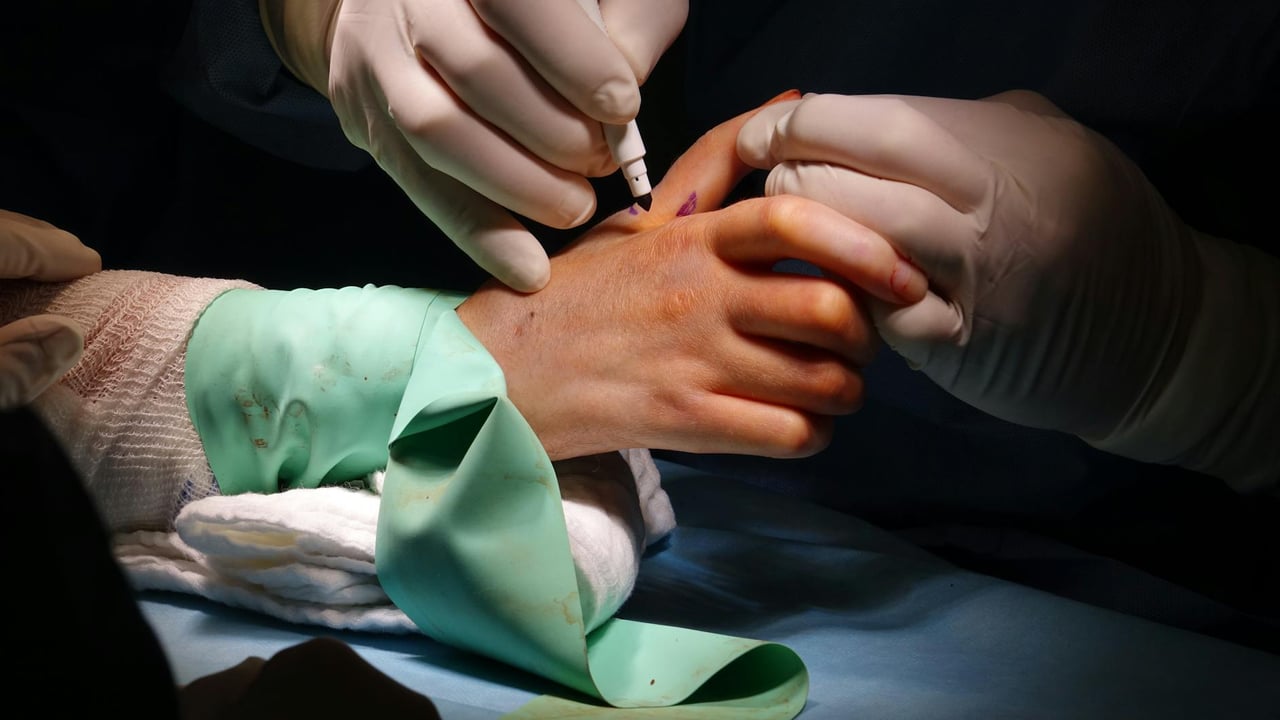

On a clear morning after snow in Shandong province, a brigade medical tent ripples with disciplined activity: triage done in moments, casualties moved in orderly fashion, surgeons and nurses performing like a well-rehearsed machine. The actors are not only front-line medics but a concentrated team of nine mid-career medical doctors with PhDs from the Army’s 80th Group Army Hospital, trained and oriented explicitly toward the demands of modern combat casualty care.
Their exercises mix laboratory science with gritty field conditions. Team members simulate shipboard roll, gale-force gusts and chemical contamination while operating in pitch-dark or low-light environments; they run multi-disciplinary emergency responses across orthopedics, neurology and respiratory medicine; and they test systems under the stress of explosions and noise. The point is to shorten decision cycles and make high-precision care possible where the battlefield is least forgiving.
The team’s work spans immediate clinical practice and applied research. Innovations described by team members include rapid 3D-printed fracture planning to compress surgical time, a field-deployable psychophysiological monitoring-and-intervention system to detect and mitigate acute stress responses, and procedural refinements validated in thousands of simulations and clinical cases. Their outputs—some 64 peer-reviewed papers, dozens of patents and scores of new techniques—are being fielded in training units and showcased at regional military medical conferences.
Individual vignettes illustrate the broader trend. A respiratory specialist performed an emergency bronchoscopy on a soldier in a makeshift tent; an orthopedist and two colleagues jointly salvaged a severely injured trainee during live explosives training; another doctor crawled through trenches under simulated fire to keep all trauma kits functional. These scenes are framed against a broader institutional push: the hospital’s mission is explicitly tied to the PLA reform-era imperative of “winning” on future battlefields.
The team has formalised feedback loops with combat units, turning operational shortfalls into research priorities and new techniques. Data from field tours—ranging from high-altitude border posts to island garrisons—feed a rolling list of problems to solve, from cold-weather vascular access to rapid fixation of complex fractures. That emphasis on “research directly for the fight” shortens the pathway from laboratory bench to treatment on the line.
That pathway matters for two reasons. First, improving casualty survival and rapid return-to-duty increases a force’s effective endurance in protracted or expeditionary operations. Second, these capabilities reduce the operational friction that a battlefield casualty crisis can produce; quicker, more reliable medical response sustains morale and mission tempo. China’s investment in medical adaptation therefore complements broader military modernisation, from logistics to precision firepower.
There are wider implications beyond the PLA’s immediate operational utility. The team’s technologies and practices—portable psychophysiology monitoring, rapid 3D modelling, austere-environment bronchoscopy—are dual-use, applicable to disaster response, frontier healthcare and civilian trauma systems. Yet the emphasis on combat-relevant metrics and the integration of research within military command structures also underscore how medical science is being marshalled to serve strategic ends.
For an outside observer, the story reveals a methodical, system-level approach: combine elite clinical talent, realistic training conditions, iterative field validation and a clear operational mandate. The result is not merely incremental improvement in trauma care but an organisational template for how the PLA plans to close the gap between doctrine, technology and practice when it comes to sustaining forces under fire.
The immediate takeaways are practical: faster, more reliable emergency interventions; multi-disciplinary teamwork stressed under combat conditions; and scalable techniques adjudicated by both simulation and real cases. In aggregate, these advances contribute to a more resilient and expeditionary health service for China’s armed forces, with potential spillovers into civilian emergency medicine and regional military medical cooperation.