
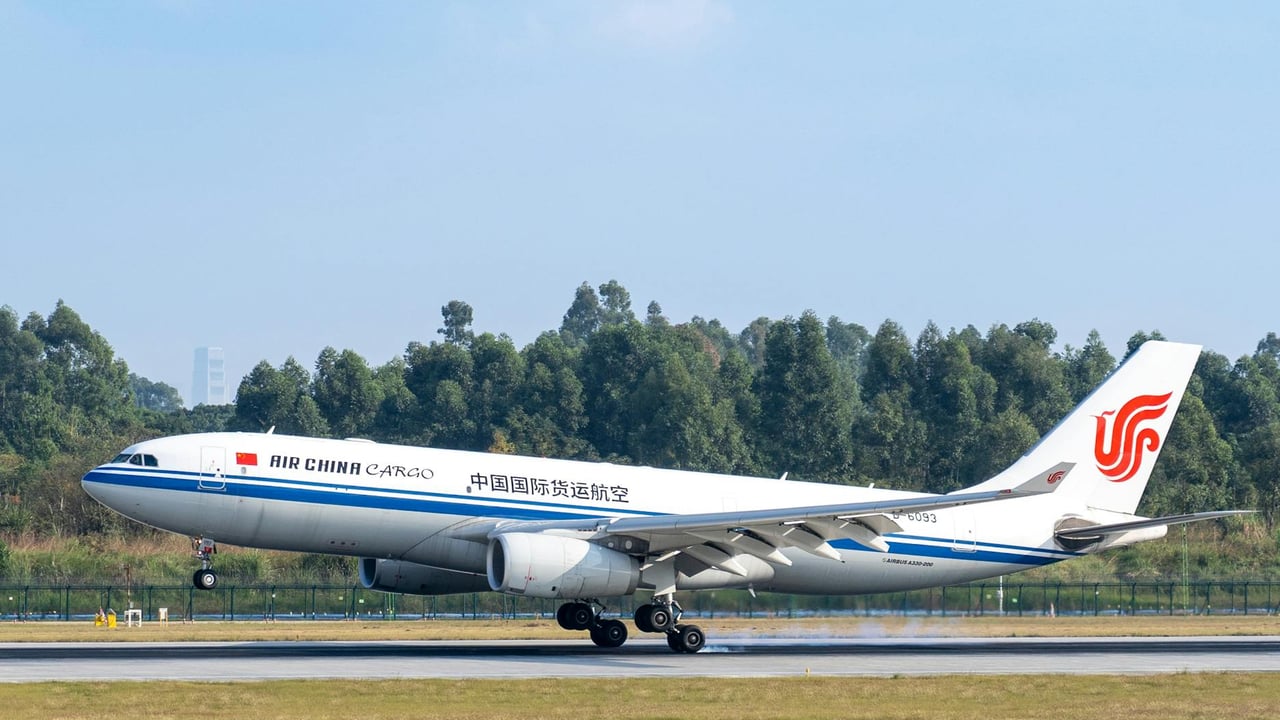

A converted Airbus A330-200 freighter operated by JD Airlines departed Chongqing for South Asia on February 12, carrying textiles and mechanical parts — the latest sign that China’s e‑commerce platforms are moving beyond parcel delivery to become full‑service international cargo operators. The A330, JD Airlines’ 12th aircraft and its first wide‑body freighter, entered the fleet in early January and already completed domestic runs carrying Xinjiang beef and mutton between Urumqi and Beijing.
The move marks a clear upgrade from the narrow‑body Boeing 737-800 P2F conversions that have formed the backbone of JD’s fleet to date. With a maximum payload of roughly 60 tonnes — nearly three times the capacity of a typical narrow‑body freighter — the A330-200P2F allows JD to carry larger consignments over longer distances and to concentrate shipments through fewer, higher‑volume services.
Behind the acquisition is a fast‑tracked commercial effort: Airbus began talks with JD in early 2025 and, through bespoke commercial terms and leasing arrangements, accelerated a process that normally takes more than a year into five months. Airbus executives say the transaction exemplifies the company’s rising share in mainland China’s freighter market, where orders for new wide‑body freighters such as the A350F have also been placed by regional carriers, and where A330 conversions are becoming standard for several domestic cargo airlines.
JD Airlines — registered in 2019 and in commercial operation since 2022 — is the only major Chinese carrier built and operated by an e‑commerce platform. The airline plugs directly into JD Group’s logistics empire: JD Logistics holds a controlling stake in domestic heavyweight Deppon Logistics, the group runs more than 130 overseas warehouses with over 1.3 million square metres under management, and its retail and last‑mile services (JoyExpress and Joybuy) have expanded across Europe with one‑ and two‑day delivery promises.
The timing dovetails with robust international freight demand: China’s international cargo volumes rose strongly in 2025 and Chinese carriers captured an enlarged slice of a burgeoning global market. But capacity alone does not guarantee international success. Chinese regulators allocate international frequencies under a class system that limits new routes when slots or bilateral allowances are scarce. Cargo airlines also face structural inefficiencies on many outbound routes — notably to South Asia — where return legs often fly partly empty, inflating unit costs.
Infrastructure upgrades at regional airports create openings, however. Chongqing Jiangbei’s new T3B terminal and fourth runway have pushed throughput to record levels, and several inland and regional hubs such as Wuhu, Chengdu, Shenzhen and Xi’an are being developed and marketed as international cargo gateways. JD has chosen Wuhu Xuanzhou as its core hub in the Yangtze River Delta, seeking a model comparable to rival parcel carriers’ hubs at Ezhou (SF Express) and Jiaxing (YTO), even as the network remains at an early stage of maturity.
Strategically, the A330 acquisition signals JD’s intent to knit its platform inventory and warehouse footprint to an owned long‑haul air network, reducing dependency on third‑party integrators and improving control over cross‑border fulfilment times. For Airbus, the deal reinforces a shift in China’s cargo market away from a narrow‑body‑dominated fleet toward more wide‑body capacity, opening fresh competition with traditional freighter players and with Boeing’s conversions.
The broader implication is that air‑cargo is becoming an arena where technology‑driven retailers can leverage scale and platform data to reconfigure global supply chains. The near term will test whether JD can turn wide‑body lift into profitable, regular international services: success will depend less on aircraft type than on securing bilateral rights, filling return legs, and integrating airport capacity with its fast‑growing warehousing and retail network.