
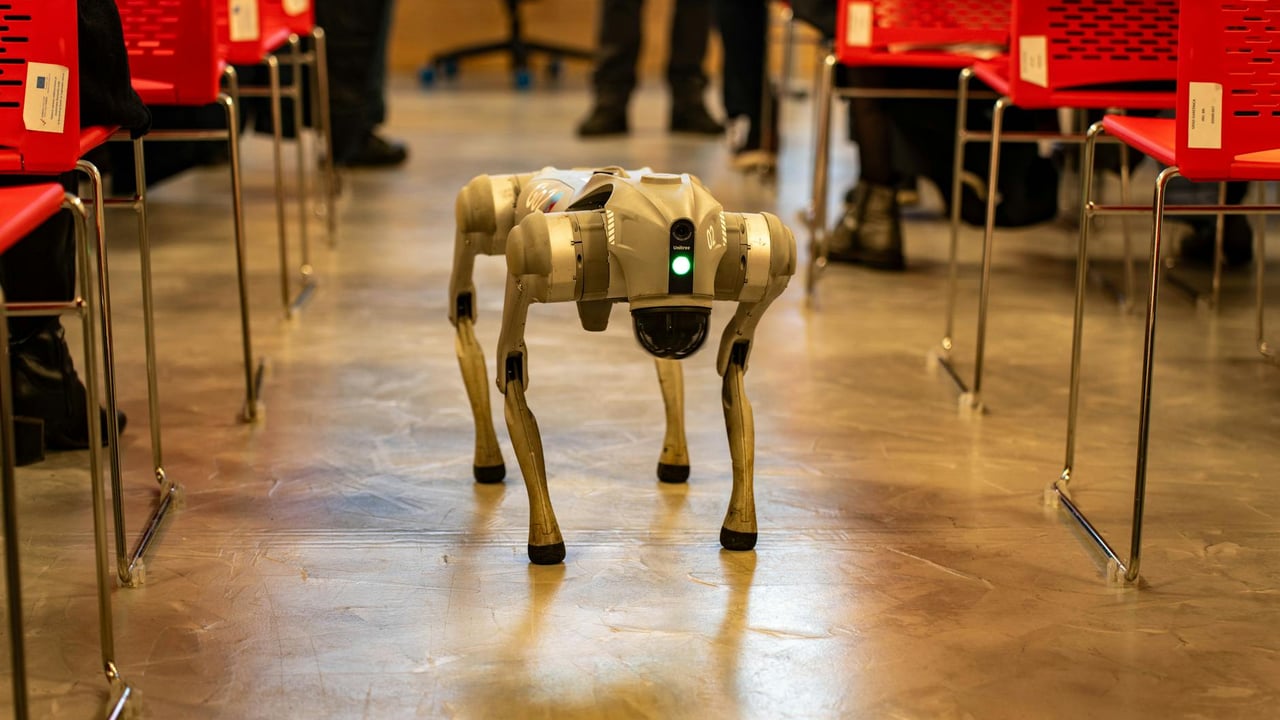

At a high‑profile artificial intelligence summit in New Delhi, a faculty member from Galgotias University presented a four‑legged robot called “Orion” as the school’s own research achievement, only for the claim to be exposed within hours as false. Social media users identified the device as a commercially available, Chinese‑made quadruped widely sold for research and teaching; footage of the presentation, briefly shared by India’s electronics and IT minister, was deleted after the error came to light.
Organizers of the Indian Artificial Intelligence Impact Summit responded quickly: they told the university to dismantle its booth and leave the event, and sources said the power to the exhibit was cut. The university subsequently acknowledged that the robot was produced in China and said it had been purchased as a teaching aid, attributing the misstatement to “poor communication.” Opposition politicians characterised the episode as an embarrassment that damaged India’s image as a rising technology hub.
The episode matters because it landed at the intersection of schoolroom procurement, national technology branding and geopolitics. New Delhi has long pursued an economic and political narrative of technological self‑reliance, and Indian universities and start‑ups routinely face pressure to demonstrate indigenous capabilities. In that atmosphere, the difference between demonstrating a laboratory setup and claiming a product as domestic intellectual property is not merely academic; it shapes funding, partnerships and public trust.
Beyond the immediate embarrassment, the incident exposes practical weaknesses in event vetting and institutional governance. The AI summit is organised by India’s electronics and information technology ministry, and the event has already attracted criticism for organisational lapses and security problems. For international participants and potential investors, the affair raises questions about the credibility of India’s public showcases and the robustness of due diligence at high‑profile technology gatherings.
For observers of global technology competition, the story also illustrates a broader reality: high‑quality, off‑the‑shelf robotics platforms from Chinese manufacturers are now ubiquitous in education and research. That ubiquity complicates simple narratives about “indigenous” capability, because institutions often build novel software, sensors or experiment packages on top of commercial hardware. Distinguishing legitimate research adaptation from misleading claims of authorship will be a growing challenge as hardware commoditises and software becomes the main locus of innovation.
The political fallout is predictable. Opposition parties seized on the episode to criticise the government’s competence and the summit’s management, turning a technical misrepresentation into a wider narrative about governance and national prestige. For Indian academia, the immediate lesson will be procedural: clearer procurement records, transparent accreditation of research outputs, and improved communication at public events to avoid conflation between purchased teaching tools and original inventions.
Small as the episode may seem, it is emblematic of how technology, identity and reputation interact in an era of intensified geopolitical competition. The incident is unlikely to alter the course of India’s technology ambitions, but it will make organisers, institutions and policymakers more sensitive to the optics of “indigenisation” and more cautious about the evidentiary standards they apply in public demonstrations.