

China’s electric-vehicle market crossed an unmistakable threshold in 2025. Nationwide penetration topped 50% for the first time and peaked at about 59.5% in November, meaning nearly six of every ten new cars sold were battery-powered. That milestone signals a shift from an era when subsidies and incentives were the industry’s life support to one in which product strength, cost control and technological edge will determine winners.
Two practical developments made the switch inevitable. Public charging capacity expanded rapidly — the country reported roughly 19.322 million charging connectors by November 2025, up 52% year-on-year — while battery ranges typically extended into the 500–700 km band and a few premium models exceeded 1,000 km. Meanwhile, fast-charging and battery-swap networks proliferated: swap-station counts exceeded 5,000 by the end of 2025 and highway service-area charging coverage surpassed 98%.
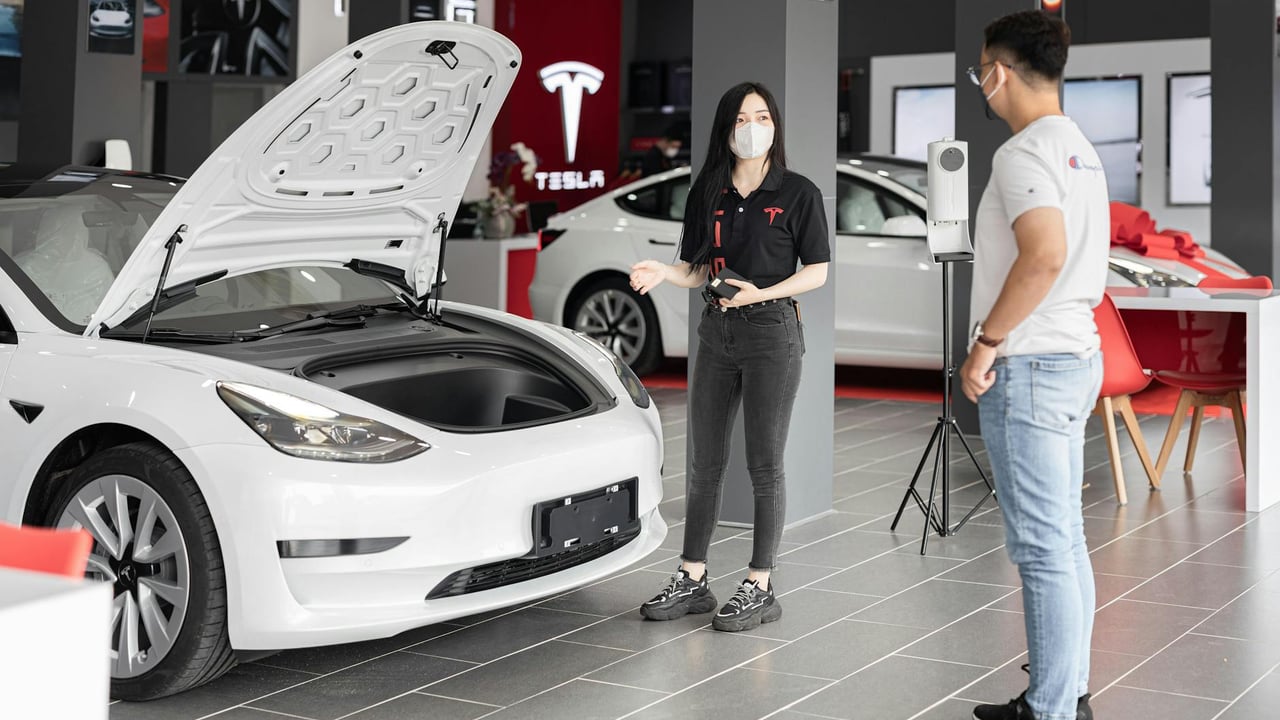
The market structure is undergoing its own convulsion. Tesla’s China retail sales fell 4.8% to 625,900 units in 2025, ending its era of unchallenged dominance. Domestic firms vaulted to the fore, led by BYD, which sold about 3.4845 million vehicles (down 6.3% but still holding a 27.2% share). Geely surged to second place with roughly 1.5646 million units, up 81.3%, and Changan grew strongly to take third. Newer entrants have also accelerated: Leapmotor climbed to 529,500 vehicles, up 86.3%, and Xiaomi Auto debuted on the sales list with about 411,800 units, a 200.9% jump.
That dynamism produced both innovation and brutal competition. Chinese brands now refresh line-ups faster than foreign rivals, and a parade of new models in 2025 — from Xpeng’s MONA M03 and P7+ to Xiaomi’s SU7 and follow-up YU7 — exposed gaps in incumbents’ product cycles. Price cuts, triggered by Tesla’s early-2025 reductions, fueled a year-long pricing war that squeezed margins and transmitted cost pressure through the supply chain. Some OEMs shortened suppliers’ payment cycles to 60 days to staunch the damage, but the industry increasingly faces a bifurcated outcome: deep-cost players forced to fight on price and others seeking to build technological or ecosystem moats.
Policy changes sharpened the transition. China ended a decade of full purchase-tax exemption for new-energy vehicles at the start of 2026, replacing it with a 5% tax and lowering the maximum per-car tax break from RMB 30,000 to RMB 15,000. Trade-in subsidies were restructured from fixed payments to price-linked proportions. Those moves produced a late-2025 “last-minute buying” surge and, more importantly, signalled that EV makers must become self-sustaining rather than rely on fiscal support.
The next battleground is intelligence. In 2025 the industry loudly promoted “smart driving” as the electric car’s second act. Firms touted advances in visual-language models (VLMs), visual-language-action systems (VLAs) and world-model approaches, with BYD, NIO, Li Auto and Xpeng each announcing ambitious software or chip programs. Yet progress to higher Levels of autonomy was uneven. Regulatory approvals for genuine Level-3 operation were narrow: authorities authorised Changan’s Shenlan SL03 and BAIC’s Arcfox Alpha S for limited scenarios and speeds. High-profile incidents and consumer anecdotes of abrupt braking in urban driving have dented trust, revealing a gap between marketing claims and real-world robustness.
Charging and swap technologies are evolving in parallel. Huawei unveiled a 1.5MW ultra-fast charging solution; BYD and Zeekr moved forward with megawatt-class, liquid-cooled flash chargers; and industry standards are trending toward 800V platforms and 5C charging rates. Battery swapping is no longer NIO’s exclusive domain. CATL reported building over 1,020 Chocolate swap stations and 305 QiJi stations, aiming to scale to more than 3,000 swap stations across 140-plus cities in 2026 and an eventual long-term target of 30,000. NIO has nearly 3,700 swap stations, and swap-focused firms are moving toward broader ecosystems and public listings.
Product diversification is now the norm. Pure battery-electric vehicles compete with plug-in hybrids and range-extender architectures, and 2026 looks set to bring a wave of range-extended offerings from both Chinese new entrants and legacy global makers such as Ford, GM, Toyota and VW. The result will be a more segmented market that rewards firms able to match real-world use cases — urban commuting, long-distance travel, commercial fleets — with differentiated powertrains and service models.
What matters beyond the numbers is the quality of the competition. With subsidies receding, the industry will be judged increasingly on software maturity, supply-chain resilience, cost discipline and user experience. Brands that can stitch together chips, cloud data, software updates and charging or swapping networks will have structural advantages. Equally, regulators will play an outsized role: safe deployment of advanced driver assistance and autonomous features will determine consumer trust, and with it, adoption trajectories. 2026 will therefore be the true test of whether China’s EV industry can translate scale into sustainable, profitable leadership rather than simply continuing a high-volume, low-margin scramble.