
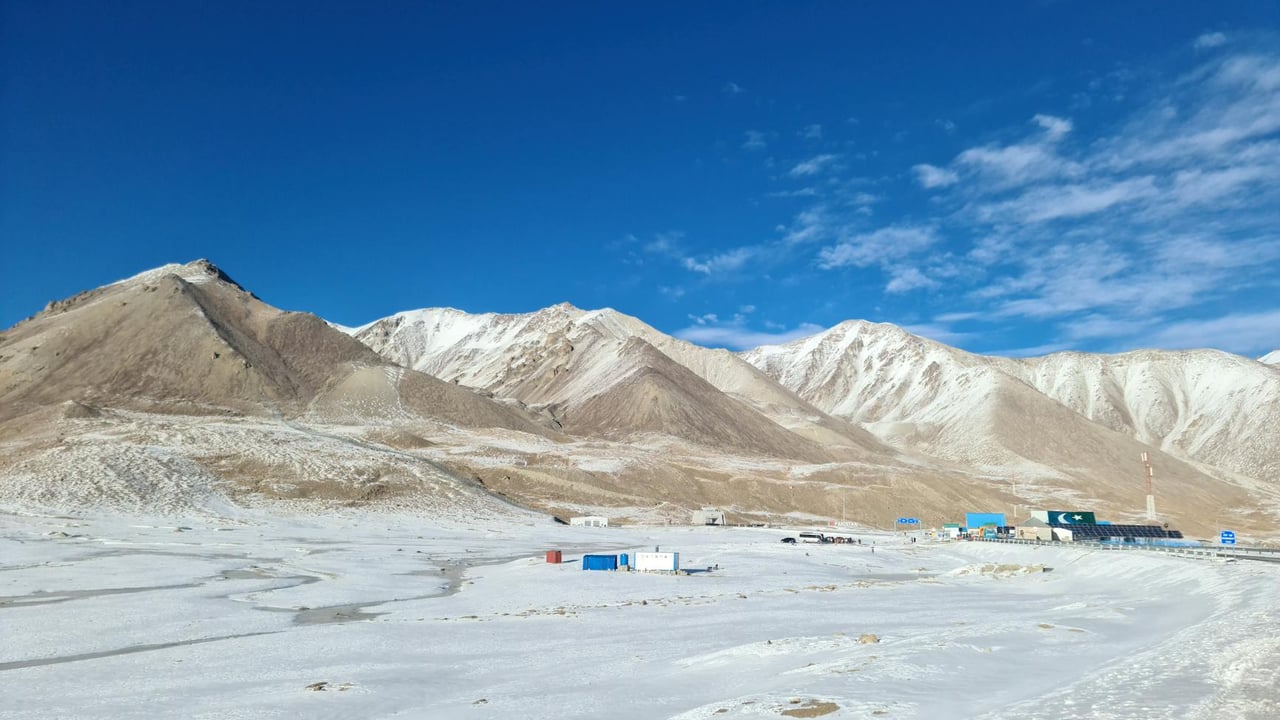

On the evening of February 15, beneath a pair of oversized red lanterns and the cold stars over the Kunlun foothills, a small border company in Xinjiang staged what it called its own "Spring Festival Gala." The unit at Simuhana — described in state reporting as the "first post on the western frontier" — transformed its indoor training hall into a village hall: U‑shaped tables, festive decorations and children perched on laps, while a string of short performances alternated with songs and applause.
The programme mixed the personal with the professional. Young soldiers told of why they enlisted after seeing rescue troops in flood-hit Hebei; a cavalryman who has spent much of his married life on patrol crooned an awkward but earnest love song while his wife stood in the audience; a clarinettist from a joint military band walked out into minus‑25C weather to play for sentries on duty. A pair of Uyghur soldiers danced with colleagues from across China as toddlers mimicked their steps.
This was not entertainment for entertainment’s sake. The report emphasised training, new equipment and a recent top score in winter exercises that earned the company the honourific "Model Western Frontier Company." Organisers framed the evening as part celebration and part solidarity ritual: a way to reward family visits, to humanise soldiers, and to make the everyday grind of patrols and watchstanding feel like a shared national purpose.
Small details were selected to carry larger messages. The clarinettist’s reference to performing during the Sept 3, 2025 Beijing review tied the isolated outpost to the centre; the presence of multi‑ethnic troops and families served as an implicit demonstration of the People’s Liberation Army’s claims about unity in the region. Cold hands and frostbitten instruments underscored the harshness of frontier service even as laughter and applause emphasised resilience and care.
For international readers, the scene is both intimate and instrumental. Domestically, political and military leaders have long used cultural rituals to strengthen cohesion in difficult postings and to reassure citizens that the state attends to the welfare of troops. In Xinjiang, however, those rituals carry added weight: the region is a strategic borderland where Beijing’s security, integration and governance policies have been intensely scrutinised. A family‑centred gala that shows soldiers relaxed, multi‑ethnic units celebrating together and concerted investment in training helps the state present an image of normalcy and legitimacy at the periphery.
At the same time, the event also signals operational readiness. The narrative repeatedly returns to patrols, watchstanding, and the application of new equipment and tactics, portraying cultural outreach and hard training as complementary: morale bolsters vigilance, and ceremonial ties to the capital reinforce discipline. For a military in the midst of modernisation, rituals that link troops on remote posts to the symbols of national power are a low‑cost way to shore up commitment and to project internal cohesion.
The Simuhana gala thus sits at the intersection of morale management, domestic messaging and frontier governance. It is a vivid example of how the PLA uses culture and ceremony to sustain operational effectiveness in austere environments, and how the state packages those efforts for both local and national audiences.